Tuesday, 7 May 2013


Apologies for the delay, at long last I’ve had the opportunity (and, perhaps more importantly, the inspiration) to write another update on life here in Malawi. For ‘regular viewers’ out there, this will probably be my last post whilst on this trip, though whether or not it also constitutes the last ever remains to be decided.

Nonetheless, it may be the end of the chapter, but it’s not the end of the book. 3 months have come and gone. Our time as a team in Malawi is rapidly drawing to a close. I’ve already spoken about legacy, so I don’t want to dwell on that too much. Yet, I also mentioned previously about the beginnings of an idea, one that will hopefully translate into reality once I’m back home – it is this that I want now to discuss. 

Education is the backbone of development in Malawi. Nevertheless, many Malawian children are unable to fully pursue their education and fulfil their academic potential. The principal obstacle is cost. Although primary education is free, secondary education remains subject to tuition fees, which immediately exclude learners whose families are unable to financially support their studies.

Hardest hit are orphans. Already victims of the HIV/AIDS epidemic and stigmatised by society, their extended families struggle to meet even their most basic needs, let alone pay for their schooling. Even at primary level, their progress lags behind the other pupils; orphans can represent up to 20% of a school’s intake, but only a third of them will pass their final exams (as opposed to the 50% pass rate of other learners) and hardly any of them will be selected for secondary school (let alone be able to afford it).

These orphans, who have the potential, but not the opportunity, to attend and succeed at secondary school, are the ones whom I wish to target. In essence, I seek to set up a funding mechanism that will enable them to obtain a secondary education and thus break out of their impoverished circumstances. Such an education significantly enhances their prospects, opening up the possibility of university and also a diverse range of career paths; options that would otherwise be unavailable to them. Just £100 would cover one pupil’s tuition fees for the entirety of their secondary education.

Now, some of you reading may be worried that I’m about to make an impassioned plea for your money, akin to Comic Relief or Band Aid. Not so. I write about this venture simply to share a personal conviction and to raise awareness of a forgotten plight. If people want to support this venture then fine, but I do not want to force or guilt trip anyone into doing so. I merely wish to reiterate a point made months ago, about the ripple effect: one small act for good can have huge repercussions, far beyond our wildest dreams. In our families, in our society, in our world - what ripples will YOU make?  

Tuesday, 23 April 2013


Apparently, so I’m reliably informed, the UK has finally experienced its first rays of sunshine this year. I’d like to take this opportunity to also shed some light on just two of the projects that we’ve recently engaged in, both of which epitomise sustainable development.

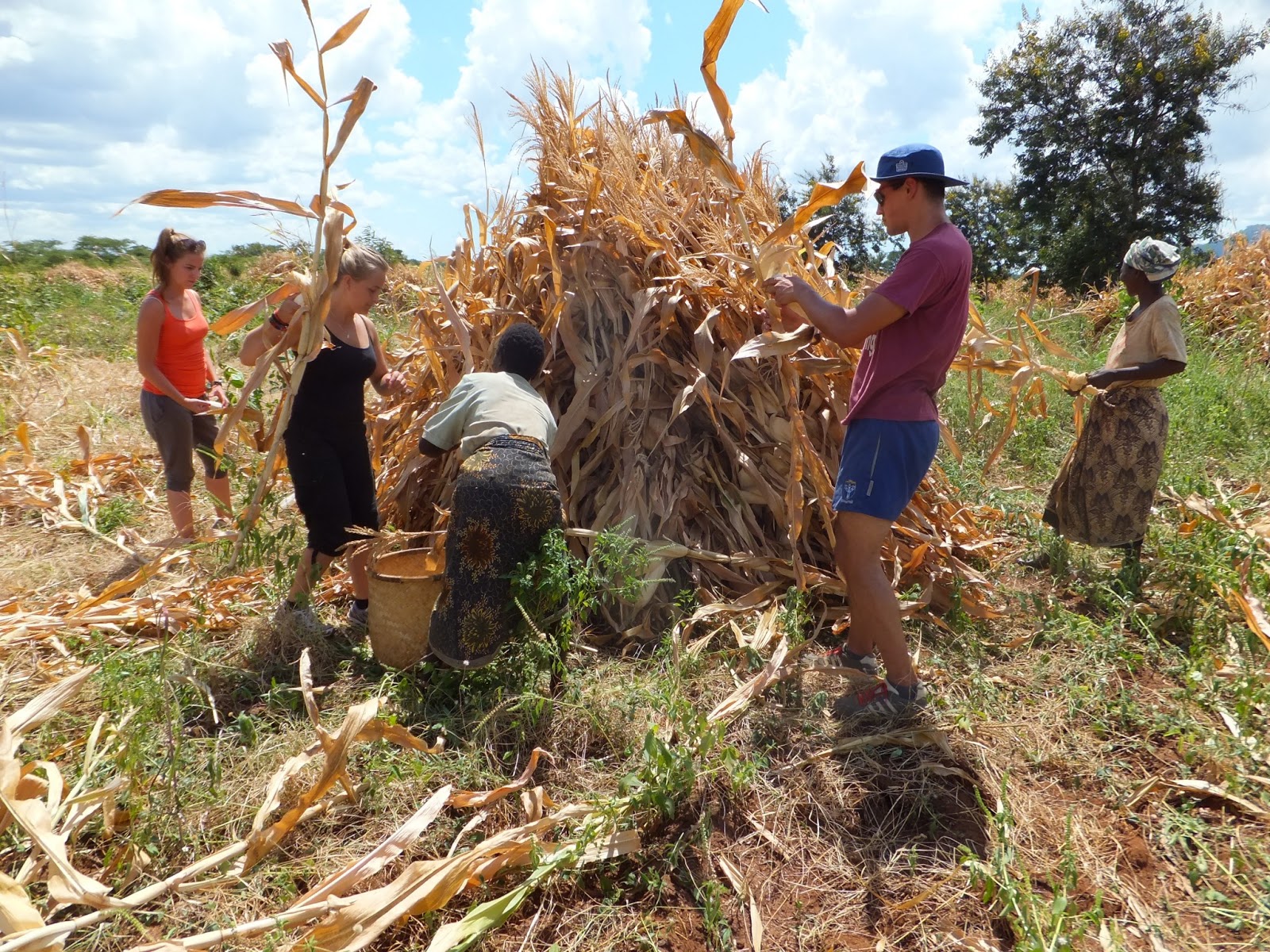
This week, we’ve all been busy in the fields, harvesting maize. The stalks can grow upwards of 10 feet and take some effort to cut down, pile together and then strip of the cobs. Nonetheless, it’s given us a great insight into the success of ‘conservation agriculture’. This basically means farming so as to make the most of all the natural resources that are available and thus maximise crop yields. I won’t bore you with all the technicalities, but suffice to say it uses simple methods (like mulching) to achieve stunning results. The villagers we were helping had only just adopted it, yet enjoyed vastly improved yields, some double or triple previous amounts. In a country where 85% of the people live off what they grow (i.e. subsistence lifestyle), this is a welcome step forward. 


We’ve also been passing on skills and knowledge in the area of sanitation. We’ve visited various rural communities and taught local workmen how to construct ‘ecosan’ toilets. These toilets can be easily constructed with readily available materials and tools, but dispose of the waste in a safe, hygienic and environmentally friendly way. The workmen join us as, together, we build a demonstration toilet; they can then use their training to build toilets elsewhere. This equips the workmen with employable skills and simultaneously benefits the wider community, such as by reducing diseases associated with poor sanitation.

Both these schemes provide expertise whose lifespan and benefits will be endure long after we have returned back home. There is no ongoing investment required. To reiterate a common thread that has run through many of these blog posts, the people have been empowered to help themselves. 

Wednesday, 17 April 2013


Before the London 2012 Olympics, one of the key buzzwords was ‘legacy’. Once the fleeting moments of sporting spectacle had passed, what would be left to show for it all? What would be the long term impact on the surrounding community?

In a similar vein, I’ve been thinking about the ‘legacy’ of our trip out here in Malawi. Maybe legacy is too grandiose a term, but I think it aptly conveys the sentiments that I’m seeking to express. We’ve only one month left in this country, so what will we leave behind? What will be the lasting effects of our time spent here?

Obviously, as brilliant as our collective talents are, we’re not expecting to witness some sort of national transformation in the wake of our stay. Nevertheless, the impact that we’ve had can still be observed, measured and continued.

Much of our work has entailed passing on skills and knowledge to communities, whether in schools, villages or churches. It may be (inter alia) how to manage a business, how to obtain better crop yields, or how to ensure basic personal hygiene. These things, although intangible, will benefit not only the immediate recipients, but also can be passed on to fresh audiences: the ripple effect (cf. earlier blog). It empowers people to help themselves, rather than rely on others for help.

Accordingly, we can start to undermine the insidious dependency culture that has arisen in Malawi (and indeed in much of Africa). We may not have a freshly painted classroom or a gleaming new block of toilets to show for our own efforts, but the success of our trip is not to be measured in bricks and mortar. Our focus has been on people; on equipping and empowering them to break out of the cycle of poverty that has entrapped them.

We hope that our work echoes the ethos of The Big Issue magazine back in the UK, whose slogan is ‘a hand up, not a hand out’. Many Malawians simply need a helping hand to get them on to the first rung of the ladder, the ladder by which they can climb out of their impoverished circumstances and improve their lives. Imparting skills and knowledge is one means of achieving this. Another means, equally sustainable but requiring initial capital outlay, is setting up microfinance schemes.

These projects all concern what has already happened on this trip – our immediate legacy. I hope soon to share information about a new project that will start once this trip has finished, which will, I trust, be a blessing to Malawi too.

Saturday, 6 April 2013


It was both refreshing and heartening to celebrate Easter here in Malawi last weekend. Absent were all the commercial trappings and media distractions to which we have become so accustomed in the UK. No eggs, no rabbits, no self-aggrandising celebrities. The focus was solely on ‘the reason for the season’ – Jesus Christ.

More generally, life is a lot less cluttered here. Societal superficialities like materialism and hedonism do not hold much sway. And, with these stripped away, it becomes clearer to discern what people truly value. The focus is on people, not things.

For Malawians, relationships are vitally important. They possess intrinsic, not instrumental, value. People are interested in and value each other. It’s not restricted to family ties and bloodlines. Nor is it about maintaining a façade of friendliness, or making a connection in order to grab a deal in the marketplace. Anything more than an exchange of pleasantries with a stranger in England and we automatically get suspicious. ‘What are they after?’ ‘What’s their motive?’ But here, people go out of their way to build relationships, willingly sacrificing their time so that they can get to know you.

Malawi is heralded as ‘the warm heart of Africa’, owing to the friendliness of its citizens. After spending nearly 2 months here, I can certainly affirm this sentiment. Without wishing to sound judgemental, I do believe that it is something that we can learn from in our own culture. Don’t get me wrong, things are far from perfect here. Yet, in spite of the daunting problems that face Malawi, its inhabitants still exhibit a measure of contentment, fulfilment, even joy, that I rarely encounter back home in England. I think a principal reason for this is the investment that people make in relationships; poverty may preclude the pursuit of possessions and pleasure (as we conceive them), yet the people here are not dispirited. Far from it, for they treasure something else instead – each other. 

Saturday, 30 March 2013

Observing the overwhelming need that exists in Malawi, it is all too easy to become disheartened. The problems are myriad, the solutions seemingly elusive. Poverty here resembles the hydra of Greek mythology: cut off one head (or tackle one issue), and two more appear in its place.

In light of this pessimistic outlook, it seems natural to adopt a defeatist stoic position, to accept the status quo and acknowledge the futility of trying to effect change. Anything else seems just a rose-tinted view of reality or wishful thinking.

But this in itself illustrates part of the problem of poverty. It enslaves its victims mentally as well as physically. This can take several forms. Poverty can breed a mindset of hopelessness and negativity, which begets only despair. Often, the communities we encounter here have the wherewithal to change their circumstances, but they lack the belief, the courage and the initiative to do so. Alternatively, the communities here demonstrate a subconscious acceptance or acquiescence to poverty; things have been like this for so long, that is how it will always be.

Breaking these mindsets and empowering communities to take responsibility for their problems constitutes a significant proportion of our work here. We don’t want to provide unsustainable solutions or foster false hope, but we do want to bring people to a simple realisation:

To acknowledge what is real, without accepting that what is real is also final.

Our present does not need to dictate our future. We can take a stand and refuse to be victims of circumstance. We do not ignore or discount our problems, but we instead focus on solutions.

This may appear straight out of a business seminar or even a church sermon (though, as for the latter, I feel more than justified since it is Easter Weekend). The validity of the principle, whether you endow it with secular or religious overtones, remains unaltered. Moreover, its scope is universally applicable, relevant as much to England and the rest of the Western World as it is to Malawi.

God bless, and Happy Easter :)

Monday, 25 March 2013


This week, I wish to focus on one specific project, which aptly illustrates the difference between dependency-inducing aid and sustainable development.

The project in question concerns a particular village within the Salima District. Despite bordering Lake Malawi, the area is very susceptible to drought. Most people rely on subsistence farming, but if the rains are insufficient, then they have neither the food to eat nor the means to obtain it. This project, by providing a secure income source to the villagers, acts as a safety net if the crops fail; the villagers can use the profits to supplement their nutrition, and thus avoid starvation.

So what is this project? Well, this ‘income source’ comprises the manufacture and retail of fuel-efficient stoves. The charity we’re working with (AGREDS – Assemblies of God Relief & Development Service) firstly set up a loans and savings scheme within this village. This enabled the villagers to purchase the requisite equipment for making the stoves. Using only readily available materials (namely, bricks, soil and water), the stoves can be churned out at a rate of 60 per day. These are then purchased by the charity at a fair price and sold in local markets.


Already, the villagers have repaid their start-up loan and have set aside all their profits in a bank account. This money will then be distributed to the village as and when the need arises.

To the village itself, the impact is obvious. Its inhabitants do not live in fear of food shortages, as they now possess the resources to compensate for any shortfall in their maize yields. They are also able to look after themselves, rather than having to rely on handouts from the government or relief organisations. This new self-sufficiency in turn enables them to pursue more fulfilling lives: the adults have the capital to invest in enterprise and business; the children have a greater likelihood of receiving a full education.

But what difference does such a project make to the wider community, to the region as a whole? Happily, the benefits are not monopolised by this single village. Everyone in this area relies on charcoal for fuel, which is made by burning timber. Charcoal is becoming increasingly hard to obtain, due to deforestation, rising costs and the droughts (which prevent new trees growing to replenish those felled). By supplying fuel-efficient stoves, the local community can maximise the usage of its dwindling charcoal resources. In conjunction with an extensive afforestation programme, this is delivering economic and environmental benefits.   

It is projects such as this that make a real and positive difference to people in Malawi. Charities and NGOs may abound here, but this nation remains one of the most impoverished in the world. We want to help these people to help themselves, rather than fostering a dependency on foreign aid. I’ve seen with my own eyes just how projects like this can achieve this objective, and in so doing empower the target community to break out of the poverty that grips it. 

Tuesday, 19 March 2013


If variety is the spice of life, then this last week has certainly been of red-hot chilli proportions.

Monday – helped draft a funding proposal to the World Bank, aimed at combatting teacher absenteeism in rural schools. A surprisingly large problem in Malawi, it can prove seriously detrimental to students’ education; the official government teacher/student ratio is 1:60, but in reality it is often 1:100 or even 1:200. If teachers are skiving, then lessons remain untaught and the students remain in ignorance. We hope that, if funding is obtained, measures can be put in place to tackle this issue.

Tues/Weds/Thursday – visited various primary schools in Mchinji district. Primary schools have 8 years (or ‘standards’). Primary education is free, but many pupils cannot attend as they cannot afford the materials or are required to work on their families’ farms. It is not uncommon to meet pupils in the higher standards who are in their late teens or even early twenties, who have had to repeat years or start their education late. Aside from teaching on health issues (particularly relating to water, sanitation and personal hygiene), we have given lessons on geography, history and maths. All the pupils are enthusiastic and eager to learn, and are especially interested in hearing about life in England. They keenly appreciate the difference that education can make to their lives, and it has been humbling to talk to some of them and find out their future aspirations.

Friday – helped construct pit latrines in a local school. We helped prepare the foundations, collate building materials and make cement. It’s amazing how energy-draining it can be, to work under a blazing sun doing manual work. But what was more amazing were the huge crowds of pupils who gathered to watch our every move; they even formed a long line to pass bricks along to us. These latrines may look primitive, but they are surprisingly effective.

Saturday – day off! After a relaxed morning, we travelled to a local hotel to take advantage of its pool and sauna facilities. Basically a health spa, Malawian style, all for just the equivalent of £2.

Sunday – church started at 7:30AM and lasted for the best part of 3 hours. An impassioned speaker from Cameroon gave the sermon. In the afternoon, we played basketball with some local lads, on a court that was covered with puddles and wet mud. The slippery surface definitely livened up the match; I ended up on my backside at least once! Add to that a ball in the face and an elbow to the jaw, and I almost felt like I’d been playing rugby by the time we finished.

This week we’re off to the Salima District, near Lake Malawi. Stay tuned for more updates…

Sunday, 10 March 2013

After scaling the heights of Mount Mulanje last weekend, it was back to business as usual this week. Our sub-team of 3 has been based near the Zambian border, working in the Mchinji District. Primarily, we’ve been visiting schools and villages where projects have already started, to monitor their progress and also to spearhead education initiatives concerning water and sanitation.

Travelling to and from these project locations is an experience in itself. We hire taxi-bikes for the day (for the princely sum of around £5); we are then peddled around by our cycling hosts, while we try to balance on the back of the bikes as best we can. Although we do have the benefit of cushioned seats, that doesn’t offer much comfort when you’re being driven at full speed through a maize field, dodging oncoming cattle and being buffeted about by all the potholes in the road. I say ‘road’ - they’re all really dirt tracks, meandering through the lush countryside, which can turn into small rivers after a torrential downpour.  

After maybe an hour or so, we’ll reach our intended destination. We’re always guaranteed an enthusiastic reception from the villagers, who turn out in huge numbers to greet us. We usually hold some sort of communal meeting in the village, which includes a discussion forum between them and us. A lot of our work so far has centred on making impact assessments, discovering  how a particular project has benefited the community and what further improvements could be made.

We also talk about best practice, in terms of how to use water and sanitation facilities safely and effectively. Most villagers already seem to have a good level of awareness about these issues, probably thanks to previous initiatives. At times, it does feel like we’re little more than a fairground attraction – our mere presence as white foreigners adding a certain panache (but nothing in the way of purpose or practicality) to proceedings, a sort of sensationalising effect. But, it is still early days, and we will hopefully be beginning a construction project in a local school next week.

I’ve also been asked to help draft a funding proposal for our charity, which is seeking to capitalise upon a new scheme by the World Bank. There was me thinking that I could forget everything to do with my legal education whilst out here in Malawi! At least I can put my skills to good use, though as the deadline for submission is only 4 days away, it’s going to be hectic.

Must dash, I’ll send another update soon. 

Friday, 1 March 2013


Lightning coruscates across the pitch-black sky; thunder roars and shakes the buildings; torrents of rain pour incessantly through the darkness. When it rains in Malawi, there is no holding back Nature’s fury.

Remarkably, this hasn’t precipitated a power-cut (a regular occurrence here), so I can happily write this blog. Water there may be a plenty in Malawi (as the drumming rains currently testify), but it is rarely harnessed effectively by rural communities.

This inability to access and/or manage water properly can be seen in several areas. The most obvious is where villages lack even a basic source of clean drinking water. Many villages have some sort of handpump, but it is estimated by UNICEF that, at any time, around a third are out of order. In areas prone to drought, such as Salima where some of us are working, this can be particularly devastating. Sanitation also poses problems, both in terms of toilet facilities and hygiene practice. Much of our work in these villages will be in the form of education, rather than just construction. Then there is the issue of using water effectively in agriculture, in order to boost maize yields. Yields can be at least tripled through introducing simple techniques, designed to retain moisture in the soil.

Water is just one of the projects we’ll be tackling in the next few months. I’ll elaborate on the other projects more at a later date. Right, we’re climbing a mountain tomorrow, so must get some sleep! 

Sunday, 24 February 2013

Here’s just a quick snapshot on some aspects of Malawian culture that we have encountered so far. I just want to try convey something of the flavour of life in this wonderful country.

The staple crop is maize (sweetcorn). Unlike the stuff we get off the shelves in the supermarket, this has a white colour. Normally it is prepared by beating it to pulp and then cooked by boiling. The maize (‘nsima’) has a consistency that is somewhere between kneaded dough and mashed potato. Bland in taste but very filling, it is eaten without any cutlery, just rolled into balls and dipped in sauces, or eaten with meat and vegetables, depending on the resources of the host.

Family and friends will know full well that I do like my food, so I will try my best not to turn this post into a culinary bulletin. Our hosts in Lilongwe have looked after us exceptionally well and made us feel very much at home. We were also similarly welcomed by the local church we visited this morning. Service started at 7:30 AM (the same time that the working day starts in Malawi) but there was nothing sleepy about the congregation – certainly one of the most vibrant and passionate that I’ve ever seen! It was thrilling to witness people completely uninhibited in praising and worshipping God. We introduced everyone to a contemporary hymn, which was warmly received. We’re all looking forward to returning next week, maybe one of us could be asked to preach, so must prepare just in case.  

Friday, 22 February 2013


Below is the breathtaking, shimmering expanse of calm blue water that forms Lake Malawi, crowned by wisps of a majestic sunset. The countryside is equally picturesque, with lush undulating landscapes covered in maize fields.  It is hot and humid, with temperatures rising to 30*C. 


An ideal holiday destination this may sound like, but that is certainly not the reason why we are here. Although the Malawian people match the warmth of their climate (I have seldom encountered such degrees of cheerfulness and kindness), this is a nation fraught with problems. 


Poverty is everywhere to be seen. People get by as best they can, but with an ever-worsening economic crisis out here, times are tough. We moan about rising food and fuel prices in the UK, but it is minimal compared to what is happening in Malawi. The currency was recently devalued by 50% (a long overdue economic reform, recommended by the IMF and World Bank), which, added to poor harvests, has seen the living costs shoot up.

Many people (85%) live in rural areas and rely on subsistence agriculture. This often is insufficient to meet their needs. They also face issues with regard to clean water access and sanitation. HIV/AIDS is also prevalent, destroying families and leaving appalling numbers of orphans.


It is problems like this that we will be seeking to address over the next 3 months. I will detail more of what our projects are up to next time.


Saturday, 16 February 2013


D-Day approaches, countdown can now begin!

Flying out tomorrow with the rest of our 9-strong team. Overnight flight to Lilongwe, with stopover in Nairobi. Fortunately there's no chance of jet-lag, as we're flying almost due south to Malawi and not therefore through multiple time zones.

Feeling rather shattered at the moment, having spent most of yesterday and today repeatedly losing and then finding vital luggage items for the trip (mosquito net, shoes, clothes, medication, the list goes on). Moral of the story: pack well in advance, and ignore life lesson learnt at uni about doing everything at the last minute.

Before I forget, I must say a huge thank you to everyone so far who has supported me in relation to this venture, whether in prayer, in advice, in encouragement or in finance. I'm am immensely grateful to you all and it is wonderful that so many people have taken an interest and decided to invest (in whatever manner) in this project. I hope that I can keep you all adequately updated through this blog and, at least in that small way, repay you for your generosity. Know too that your input will, in turn, benefit the Malawian people whom we will meet and work alongside.


Sunday, 10 February 2013

1 WEEK TO GO!!!

Soon I'll be glad to finally put away my hat, scarf and gloves, as I depart the freezing shores of England for the warmer climes of Malawi. But what about my coat, I hear you say, the fourth member of this essential winter quartet? That unfortunately will be coming with me. Turns out that Malawi is currently in the midst of its rainy season, which means 2-4 hours of torrential rain a day, 5 days a week. This month in Lilongwe (where I'll be initially based along with the rest of our awesome team) we'll be getting 4 times as much rain as London gets during the April showers. 

Wet it may be, but this can do nothing to dampen the growing sense of excitement and anticipation among our team. As I've already mentioned, it will certainly be warm out there, and this description also applies to the people we will meet. Malawi is often portrayed as 'the warm heart of Africa', for the simple reason that its population is renowned for its friendliness. We sincerely hope that we can reciprocate that trait during our brief stay. 

We've now got a much better idea of what we'll be up to once we arrive, but I'll leave that to another post (after all, I want to whet your appetite and make you come back to read this blog again!). If you've not checked out the tabs at the top of this page (especially the 'What? Where? When?' and 'Prayer Points' tabs), then I encourage you to do so. 

That's all for now folks!


Wednesday, 23 January 2013

Two hundred years ago, a man was born who would leave an indelible mark upon Malawi. This Scottish missionary did much to improve both the physical and spiritual health of the country. His name was, of course, Dr David Livingstone.

As the bicentennial celebration of his birth nears, Dr Livingstone continues to arouse plenty of discussion in Malawi. His efforts and influence can still be appreciated, long after his departure.

Whilst I don't want to make any arrogant presumptions or draw any lazy comparisons, I do believe that our efforts as a team can similarly (albeit on a much smaller scale) bless the Malawian people long after we have returned to the UK.

It's all about the ripple effect. Take a simple example. Install a water tank in a remote rural village. The girls in the village (for it is invariably they who are tasked with collecting water) no longer have to trek for miles each day to fetch water (which may or may not be clean). They now have time to attend school with their male counterparts and, empowered by the opportunities that education provides, break through the cycle of poverty. They can now, potentially, pursue a career, maybe become a teacher or doctor and so further help their village.

Seem fanciful? This is a true story, taken from the experience of a Tearfund team in Uganda.

I hope that we can start some ripples too...

Sunday, 6 January 2013

'Don't think there are no crocodiles just because the water's calm.' (Malawian proverb) 

There I was thinking that everything was going swimmingly; more recently, however, I seem to have encountered a lot of crocodiles. Preparations continue to gather pace and the arrival of 2013 has given a new impetus to my efforts. But never before had I realised just how much there is left to do and how little time there is in which to do it! 

Flights have been booked and funds continue to be raised. My current job may not be the most glamorous, but at least working as a punchbag in customer services for a couple of months has helped with financing this trip. 

I'm also feeling physically (in additionally to mentally) jaded, having completed the cocktail of vaccinations required for travel, to guard against a myriad of diseases including yellow fever, hepatitis and typhoid. Some were live vaccines, so although I can smugly say that I didn't catch flu this winter, the side-effects have been nearly as bad.  


Health-wise, my diabetes continues to throw up hurdles. Hopefully I won't set off every security scanner in the airport when I pass through Heathrow with over 1000 needles. I also hope that the dreaded malaria medication doesn't give me a permanently upset stomach. 


Anyway, that's enough of sounding like a hypochondriac. I currently have a huge list of things to do/buy before heading out, which covers learning a bit of Malawi's common languages (other than English, it's Chichewa and Chiyao). I'm sure there are several other crocodiles lurking out there for me too...


Saturday, 22 December 2012

So it begins. To be honest, I've felt more nervous about writing this blog than actually going on this trip! I've finally managed to muster the courage to dip my toe into the water of the blogging world. How to write something that informs everyone what we as a team are doing, whilst at the same time being funny and interesting, seems a daunting challenge.

I suppose I could promise you a white-knuckle rollercoaster ride, taking you through all the highs and lows of the trip, journeying with me in an adventure that is so intense and gripping that you wouldn't dare to take your eyes off this blog. Alas, I doubt that will happen. I suspect this blog will develop at more of a plod than a canter (by analogy, think Lord of the Rings or Pilgrim's Progress, rather than Bourne Identity or Mission Impossible).

Anyway, in the next few months I will endeavour to keep you all both informed of, and entertained by, my antics before, during and after this adventure to Malawi. Not much to report so far, other than that fundraising is going well and that my arms currently have more holes in them than a Swiss cheese, owing to the frightful number of injections I've had to take (it's certainly a longer list than any I ever sent to Santa).

That's all for now folks. Have a merry Christmas, and I'll see you all in 2013...